Remember when teachers or parents told you, "Stop playing and focus on your work"? Many of us grew up believing that play and learning are opposites.
av
But neuroscience tells a very different story: When children play, the speed of synaptic connections in their brain increases by 2–3 times compared to quiet states. In other words, playing is the most efficient way to learn.
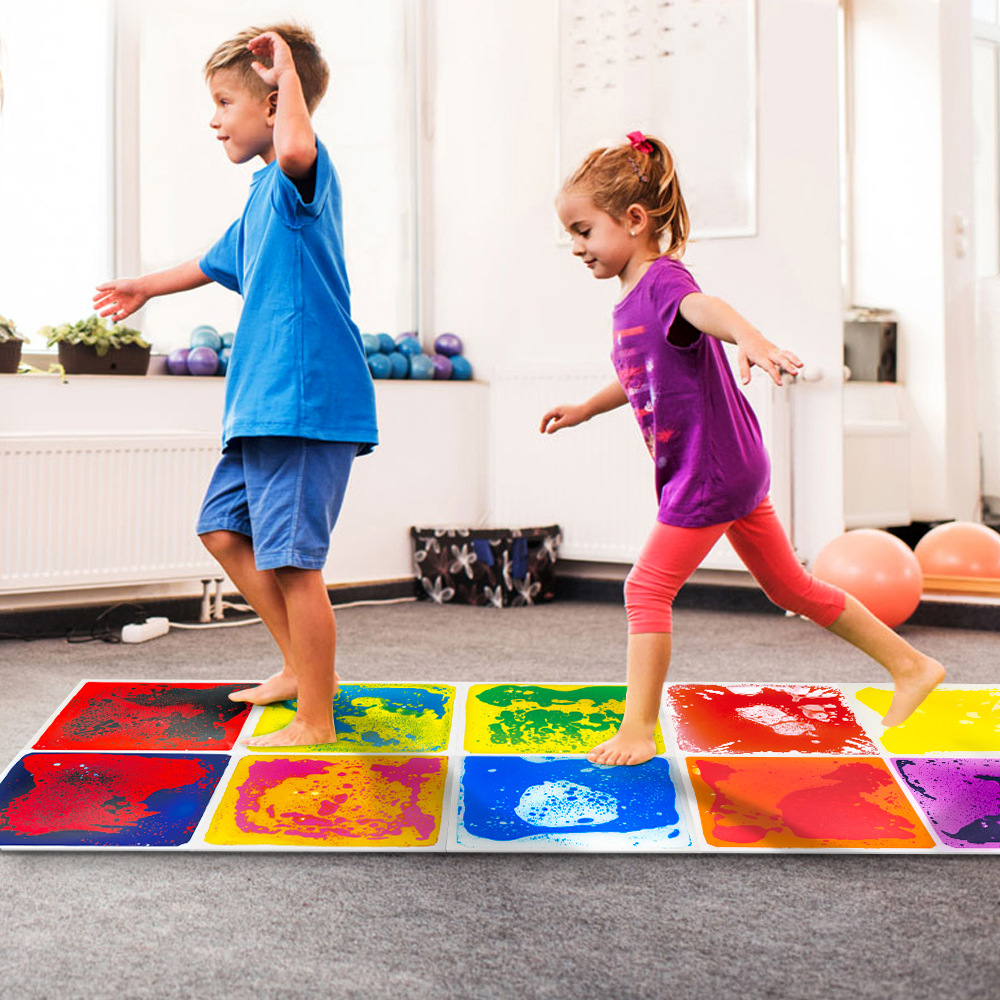
The "secret weapon" we're introducing today – Sensory Floor Tiles – perfectly blends play and learning. Through multi‑sensory integration (vision, touch, vestibular system, proprioception), these tiles let children jump, touch, and play while their brains get a powerful "upgrade workout."
The 5 activities below cover core developmental areas for children aged 3–8, graded from beginner to intermediate to challenge level. All you need is one set of Sensory Floor Tiles, and your living room becomes your child's personal early learning center.
Age: 2–4 years
Core skills: Color recognition, visual tracking, language development
Materials needed: Colorful liquid‑filled Sensory Floor Tiles + small colorful objects (blocks, toys, pom‑poms, etc.)
How to play
1. Lay the Sensory Floor Tiles flat on the floor. Have your child observe the different color sections.
2. Give a command: "Put the red block on the red area."
3. Advanced: Place a yellow object and a blue object on their respective areas, then let your child observe what color appears in the mixed zone.
🧠 Learning extensions
· Color naming and classification
· Cause‑and‑effect understanding (yellow + blue = green)
· Language expression: naming the object and its color
💡 Creative upgrade
Take your child outdoors to collect natural items (green leaves, flower petals, small pebbles). Back home, match them with the colors on the Sensory Floor Tiles.

Age: 3–5 years
Core skills: Shape recognition, spatial relations, hand‑eye coordination
Materials needed: Textured Sensory Floor Tiles + shape blocks or shape cards
How to play
1. Have your child close their eyes and touch the tile surface to guess the shape based on texture.
2. Open their eyes and find the matching shape block.
3. Advanced challenge: Use their body to form the same shape – one child makes a circle, two children cooperate to make a square.
🧠 Learning extensions
· Shape vocabulary (circle, square, triangle, hexagon)
· Understanding symmetry
· Fine motor skills and whole‑body coordination
💡 Creative upgrade
Draw a "shape map" together, plan a route using different shaped Sensory Floor Tiles, then walk along the route.

Age: 2–6 years
Core skills: Tactile discrimination, descriptive language, memory
Materials needed: Multi‑texture Sensory Floor Tiles + small everyday objects (keys, feather, sponge, pom‑pom, coin, etc.)
How to play
1. Place 3‑5 small objects on different textured Sensory Floor Tiles.
2. Have your child reach out and touch (without peeking) to guess what each object is.
3. Guide them to describe the feeling: "hard," "slippery," "furry."
4. Advanced: Recall and reposition the objects from memory.
🧠 Learning extensions
· Using and enriching adjectives
· Working memory training
· Tactile sensitivity development
💡 Creative upgrade
Two‑player cooperation: one person describes the texture ("It's cool, smooth, and metallic"), the other guesses the object.

Age: 3–7 years
Core skills: Vestibular system, core muscles, risk assessment
Materials needed: Sensory Floor Tiles (3‑5 pieces, can be connected to form different paths)
How to play
1. Beginner: Stand on a tile with both feet, hold steady for 10 seconds.
2. Intermediate: Stand on one foot → close eyes → balance a book on head.
3. Challenge: Build a "sensory bridge" by connecting Sensory Floor Tiles between the sofa and coffee table, then add obstacles (go around a toy, step over a pillow).
🧠 Learning extensions
· Body control and center‑of‑gravity adjustment
· Spatial awareness
· Resilience: try again after failing
⚠️ Safety tip: Place soft mats around the balance area. An adult should stay close to provide protection, especially during eyes‑closed or head‑balancing challenges.
💡 Creative upgrade
Set small goals: earn a sticker every time you reach the end. Collect 5 stickers and exchange for a small reward.

Age: 4–8 years
Core skills: Proprioception, muscle strength, imitation ability
Materials needed: Sensory Floor Tiles (5‑6 pieces connected into a path)
How to play
Arrange the different Sensory Floor Tiles in order. Each tile represents a different animal's way of moving:
· Bear crawl: Hands and feet on the floor, knees off the ground – crawl across the tile like a bear.
· Crab walk: Face up, hands and feet on the floor, move sideways across the path.
· Frog jump: Squat with hands on the tile, push off with both hind legs to jump forward.
🧠 Learning extensions
· Animal knowledge and imitation
· Body part awareness (hands, feet, knees, core)
· Rhythm and motor coordination
💡 Creative upgrade
· Timed race: Who can complete the "animal trio" the fastest?
· Musical movement: Play music at different tempos – switch animal gaits with the rhythm.
· Story situation: "Little Bear needs to cross the river to get honey, but a crab lives on the bridge…"

Setting up the environment
· Safe space: Clear a 2m × 2m obstacle‑free area. Remove furniture with sharp corners.
· Good lighting: Natural or bright light makes it easy to see color and texture details.
· Easy storage: Sensory Floor Tiles can be quickly connected and taken apart. After play, have your child help put them away to build organizing habits.
The adult's role
· Observer: Notice your child's "creative rules" – sometimes their inventions are more fun than yours.
· Facilitator: Ask open‑ended questions like "What else can you do with this?" or "What if we add one more tile?"
· Playmate: Put down your phone and truly engage. Your participation is the best encouragement.
Adjusting difficulty
If it's too hard If it's too easy
Break down steps, provide a demonstration, lower the requirement (e.g., "hold for 5 seconds" instead of 10) Add rules, set a time limit, introduce variations (eyes closed, carrying a weight, two‑player cooperation)
Frequently asked questions
Q: My child loses interest after just a few minutes. What should I do?
A: That's normal. Children aged 2‑6 naturally have short attention spans. Don't force it. Try an "invitation" instead of a command: "Mommy wants to play Color Hunt – can you teach me how?" rather than "Come play this game now."
Q: Multiple children fight over the same Sensory Floor Tile.
A: Set up a rotating "Tile Manager" role – each child takes turns being in charge of handing out tiles. Alternatively, use tape to mark personal zones so each child has their own "territory."

The famous child psychologist Jean Piaget said: "Play is the work of childhood."
The true value of a set of Sensory Floor Tiles is not how many "official games" it comes with, but how many original games your child invents with it. From crawling and sensory exploration in infancy to balance challenges and creative movement in the school years, it supports your child's development every step of the way.
Start with the very first game today. Lay out the tiles, crouch down, look into your child's eyes, and say, "Let's play a game."
Then get ready to be amazed by their delighted reactions and endless creativity.