When a 25-year-old unearthed a dusty set of mahjong tiles from his parents' home and brought it to his San Francisco apartment to organize a game night, he probably never imagined that tens of thousands of people would soon flock to the parties he started every month.
But that’s exactly the most dramatic moment for American mahjong. In 2026, mahjong is taking over the lives of young Americans in completely unexpected ways. It’s no longer the exclusive domain of middle-aged and older Jewish women, no longer confined to quiet community center halls. Instead, it’s showing up in trendy bars, boutique hotels, and nightclubs in New York, Los Angeles, Nashville, and San Francisco.
Slate magazine put it simply and directly: “Now everyone wants to play.” On TikTok, the hashtag #Mahjong has amassed over 280 million views, while the United States accounts for 23.4% of global online mahjong-related clicks, far surpassing other countries.
How did a "grandma’s game" become the latest hot topic among younger generations?
In the post-pandemic era, young Americans are desperately craving authentic, non-digital social experiences. Eventbrite’s data is striking: from 2023 to 2024, mahjong-related events on the platform surged by 179%. “Grannycore” has become a buzzword on social media — baking workshops, knitting circles, mahjong nights… these slow-paced, face-to-face activities are moving from the margins to the mainstream.
“A lot of people are just curious, even if they don’t actually know how to play,” said Ryan Lee, a 25-year-old founder, to the Associated Press in 2025. His San Francisco-based YLL Mahjong Club now hosts events every two weeks, accommodating up to 30 tables and over 200 guests, with a DJ spinning, custom cocktails, and dedicated instructors to help beginners.
In Seattle, a similar scene is unfolding. Sean Herrera, a 27-year-old Filipino American, started hosting mahjong socials at breweries this year through his Emerald City Tile Club, drawing over 40 people each time — mostly 20- and 30-somethings. “I think the best thing about mahjong is that you have to think, but not too much,” he explained. “That gives you time for two things — having a drink, and socializing.”
Los Angeles has taken it even further. Angie Lin started by teaching friends to play mahjong in her backyard in 2022, and has since turned it into a full-fledged business. Her company, East Never Loses, now hosts up to 14 events per month — from private parties to corporate team-building, celebrity bookings to hotel brand sponsorships. Lin told Inc. magazine that she went from hosting once every three to five months to being almost overwhelmed by demand: “The growth over the past year has shocked me a little. People come to me every day.” Her parties offer not only mahjong instruction and strategy sharing, but also Taiwanese snacks, DJ music, and visual design — transforming mahjong from a family dinner ritual into a carefully choreographed urban social drama.
All these examples share one common thread: young people are seeking “offline connection” at the mahjong table.
No retro trend goes viral without social media, and mahjong is no exception.
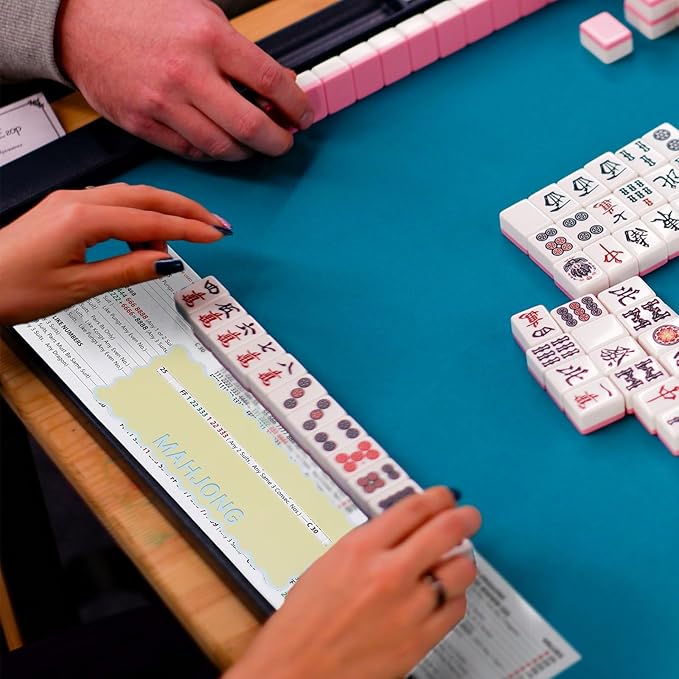
On TikTok and Instagram, the visual aesthetics of mahjong tiles are amplified. Colorful acrylic tiles, vintage-print racks, soft carrying cases — plus the crisp “clacking” sound of shuffling — are naturally suited for ASMR-style sharing. When manicured hands and tile faces appear together in the frame, American mahjong becomes a lifestyle symbol.
Even more crucially, the learning barrier has been shattered. YouTube tutorials on American mahjong from scratch — including annual updates to the National Mah Jongg League (NMJL) card — easily rack up hundreds of thousands of views. Celebrity endorsements amplify the trend: Oscar winner Julia Roberts revealed on The Late Show that she plays mahjong weekly with friends; Meghan Markle has also been spotted at mahjong games. These clips spread virally across social platforms, pushing mahjong to wider circles.
Beyond celebrity effects, grassroots creators have driven cultural output. Kilig Restaurant in Seattle hosts Mahjong Mondays; YLL Club in San Francisco mixes mahjong with DJ sets; East Never Loses in Los Angeles turns mahjong parties into “events.” All of them inject a once “slow pastime” with trendiness and personal flair.
Behind the mahjong boom lies another inescapable story — young Asian Americans are using it to rebuild ties with their homeland and older generations.
Nicole Wong, author of Mahjong: House Rules from Across the Asian Diaspora, told the Associated Press: “Mahjong is a tactile game and a very social game. It can easily connect communities.” In her view, this intergenerational interactive power is the deep motivation for younger generations to learn mahjong anew.
Seattle’s Sean Herrera put it more directly: “Culture is very important to me. I wanted to find a way to express it while also continuing my interest in mahjong.” That’s a key reason he founded Emerald City Tile Club. As a Filipino American who moved to a new city, he’s made most of his friends at the mahjong table.
Angie Lin of East Never Loses once organized an intergenerational night where bringing a player of a different age group got you free admission. She hopes the mahjong table isn’t just a “roots-seeking” ritual for the young, but also a chance for grandmothers and granddaughters to sit together again. “We want to bring the game back in an authentic way,” she told Women’s Wear Daily.
Of course, this mahjong wave isn’t solely about Asian American self-reclamation. Jewish women’s groups have been central to American mahjong’s development since 1937, and today’s revival also includes a look back at that cross-cultural history. Lindsay Hawkins, founder of Lucky Paw, initially thought mahjong was “an old lady’s thing,” but after learning it herself, she realized: “Young people’s engagement suddenly makes this game super exciting.”
This intergenerational and cross-cultural narrative is the fuel driving mahjong’s explosive popularity.
Emotional narratives aren’t enough. American mahjong’s ability to retain young players also lies in a mechanism that exactly meets this generation’s dual craving for “continuous stimulation” and “mild control.”
The hallmark of American mahjong is that the NMJL releases a brand-new card each year. From The Wall Street Journal to Reddit discussion boards, every year’s new card release is a “collective celebration.” In 2025, a printing error on the new card caused a stir across the mahjong community. This annual update provides a reassuring sense of anticipation — this year’s combination may be completely different from last year’s, meaning even veteran players must rethink their strategies, sustaining curiosity and freshness.
Meanwhile, unlike the many variations and flexible rules of Chinese mahjong, American mahjong’s standardized scoring and Joker tile mechanism offer a clearer competitive framework, suiting a society that prizes demonstrated ability. For young people, playing mahjong becomes a strategic skill to show off, not just a luck-dependent pastime.
Another layer of the game’s magic: it simultaneously provides a release for highly stimulated brains and a sense of calm order. A two-to-three-hour game demands focus, memory, and deduction, but the pace isn’t frantic and the margin for error is decent — perfect for those who want to “disconnect” without giving up mental engagement.
Demand is changing supply. On Amazon and e-commerce platforms, “American mahjong sets” are evolving at an astonishing pace.
Over the past few years, complete 166-tile sets (including the 8 Jokers needed for American play) have become standard. Acrylic tiles are gradually replacing traditional melamine, with penetration among high-end players reaching 87%. Popular soft-shell carrying cases — like Linda Li’s blue paisley bag set — have long topped Amazon’s bestseller list, with reviews praising “club essential,” “great weight, satisfying shuffle sound,” and more.
Consumer segmentation is also clear. Entry-level plastic sets are priced at $40–80, appealing to curious newcomers. Mid-range acrylic sets run $100–200, dominating club and weekend party use. The collectible tier extends to bone-and-bamboo tiles, designer collaborations, and even Rimowa’s aluminum mahjong briefcases costing several hundred dollars, with laser-engraved resin tiles inside, serving as status symbols.
Behind the consumption boom lie pain points. Many users complain that included instruction booklets are outdated, and the NMJL’s new annual card must be purchased separately, creating a “subscription accessory” market opportunity on e-commerce pages. Savvy sellers are already studying how to sell yearly update packs separately, avoiding inventory issues while maintaining repeat purchases.
According to market insights, mahjong is estimated to be a global industry of about $2.57 billion, expected to grow to $4.08 billion by 2032. Sustainability is also emerging: bamboo and recycled acrylic are growing at 19% annually, significantly faster than traditional materials.
Could this revival be just a trend? Based on today’s dynamics, American mahjong’s resurgence has solid reasons to last.
The craving for “slow socializing” over fragmented digital interaction has become a post-pandemic baseline. Compared to a movie or a meal together, a two-to-three-hour mahjong game offers a longer, more focused interactive space — a time to put down screens and truly connect with friends.
Meanwhile, the sense of “small-circle identity” within mahjong communities is quietly becoming a new form of cultural capital. Knowing how to score a “Little Three Dragons” or quickly adapting to the new 2026 card has even become a niche status marker in some urban youth social hierarchies.
The biggest challenge may lie in the tension between commercialization and cultural preservation. When mahjong nights at The Standard Hotel become city hot spots and luxury brands start selling mahjong accessories, does the “original culture” of mahjong risk being diluted and trivialized? That’s worth watching. But equally undeniable is that the 2025 retro wave is unlike previous single-style nostalgia trends — it simultaneously addresses genuine social needs, cultural narratives, and strategic gratification.
The story of American mahjong is, at its core, a story about connection. It gives young people a way to be together without anxiety or boredom; it allows young Asian Americans to re-embrace family and heritage; it gives bars and hotels a new soul beyond happy hour.
Almost everyone involved in this mahjong wave says the same thing: “It’s not just an old lady’s game anymore.”
And of course it isn’t. In fact, it never was. But in 2025, the pickiest players on the planet — young people addicted to digital screens yet yearning for real touch — finally heard, in an accidental shuffle of tiles, the timeless charm of a game that dances between order and chaos.
One set, four people, three hours. What you win isn’t just the game — it’s the real world beyond the screen.