In the journey of raising a child, every parent has likely faced this dilemma: toys keep piling up at home, but their child’s novelty wears off faster and faster. Some toys are abandoned after just two minutes of play, while others, due to poor design, may even make children more restless and distractible. So, what kind of toy can truly accompany a child through the critical period of brain development?
For children aged 0–6, these six years are precisely when neural connections form most rapidly and brain networks build most intensively. Every game and every interaction quietly shapes a child’s future learning ability, thinking habits, and emotional management. That’s why more and more early childhood experts and educators emphasize that toys should not be mere “time-killers” – they should be the child’s “first classroom” for understanding the world, developing thinking skills, and building focus.
It is with this philosophy that HBpolymers has established its core product concept: “Edutainment & Growing with Your Baby.” This is more than a slogan – it represents a return to and respect for the true essence of children’s toys: rejecting mediocre design and useless features, placing scientific enlightenment at the core, and ensuring every toy genuinely serves a child’s development.
Scientific research shows that during the first few years of life, a child’s brain develops at an astonishing rate. Vision, hearing, touch, motor coordination – each ability relies on abundant environmental stimulation. By touching different textures, recognizing bright colors, and experiencing shapes and spatial relationships, children gradually build their initial understanding of the world.
Sensory Floor Tiles are precisely designed with these developmental characteristics in mind. Unlike traditional static toys or today’s flood of screen‑based early learning products, sensory floor tiles focus on “sensorimotor experience.” When a child presses their little hand against the soft surface, the colored liquid and glitter inside flow and change slowly. The child’s eyes naturally follow, their fingers try pressing the same spot repeatedly to see the change. This seemingly simple action simultaneously engages visual tracking, hand‑eye coordination, causal reasoning, and recognition of colors and shapes.
More Than Just Play: Building Genuine Core Skills Through Games
Many parents ask: What can a sensory floor tile really bring to my child?
First, fine motor skills and manual dexterity. For children aged 0–6, the small muscle groups in their hands are in a critical development phase. Pressing, grasping, patting, touching – these repetitive yet engaging movements effectively strengthen finger control and coordination, laying the groundwork for future tasks like holding a pencil or using tools.
Second, logical thinking and observation skills. When a child discovers, “If I press here, the liquid moves” or “If I flip it over, the pattern changes,” simple cause‑and‑effect relationships begin to form in their mind. This experience of causing change through action is one of the first steps a child takes toward understanding the rules of the world.
Third, comprehensive cognitive development. High‑quality sensory floor tiles typically incorporate elements like colors, shapes, and numbers. As they play, children naturally learn to identify red, blue, circles, squares, and even begin counting and sorting with a parent’s guidance. This “unconscious learning” is far more effective than rote instruction, because the child’s intrinsic motivation is fully engaged.
Fourth, focus and patience – often overlooked by parents. In modern life, children are exposed to high‑stimulation, fast‑paced information, which can make them restless and easily distracted. Sensory floor tiles, however, operate at a pace controlled by the child: they can slowly watch the liquid flow or study a particular pattern for a long time. This “low‑stimulation, high‑engagement” play pattern is an excellent way to train sustained attention.
Many mothers report that when their children play with sensory floor tiles, they stay quietly focused for twenty minutes or more. They no longer cry for no reason, nor do they constantly ask to watch cartoons. For parents who need a moment to breathe, this is a blessing; more importantly, the child gains a truly immersive experience.
When it comes to children’s products, safety cannot be overemphasized. Especially in an era where news often breaks about toxic materials, detached small parts, or sharp edges, parents are understandably cautious when choosing toys.
HBpolymers fully understands this. The brand strictly follows a standardized production system dedicated to children’s toys. From raw material intake, through processing and manufacturing, to finished product shipping, every step involves rigorous quality inspection. Special attention is given to grinding every edge and conducting safety tests to ensure no sharp corners remain, eliminating any risk of scratching a child’s delicate skin.
The production team itself has years of experience in manufacturing children’s toys. They know which details truly matter for a child’s safety: Are the seams strong enough to withstand repeated pressing without splitting? Is the liquid enclosure secure, and if it were ever damaged, would the internal medium be safe and non‑toxic? These issues are examined repeatedly from the product design stage.
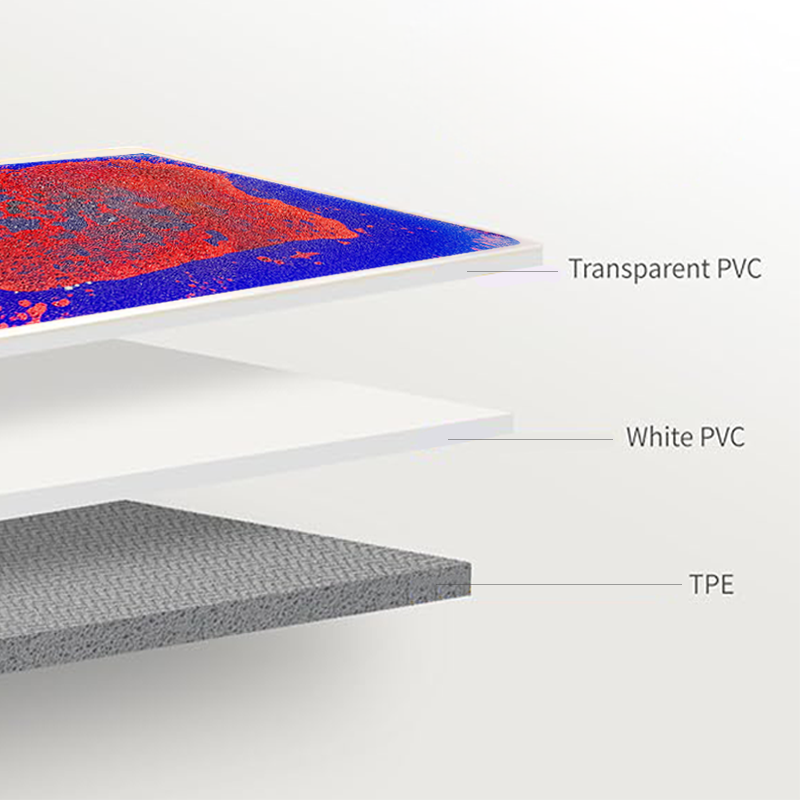
No matter how good a toy’s design is, if the material is not trustworthy, everything else is meaningless. HBpolymer’s sensory floor tiles are made from food‑grade, safe plastic material – completely non‑toxic, BPA‑free, and free from formaldehyde, fluorescent agents, or other harmful substances. Even if a child plays with it for extended periods, hugging it against their skin, it will not impose any burden on their health.
Many parents say when they first receive the sensory floor tile, their immediate reaction is: “It really has no unpleasant smell.” That’s because the brand avoids low‑quality recycled materials and cheap additives from the very source. At the same time, the material is drop‑resistant and tough enough to withstand a toddler’s “violent exploration” – after all, children don’t handle things as gently as adults do.
Another headache for daily use is cleaning. Children’s toys often end up covered in drool, juice, or mud. The surface of HBpolymers sensory floor tile is water‑resistant, making it easy to wipe clean without extra effort. Moreover, the seams are reinforced with a leak‑proof process, so even after repeated bending or pressing, no leakage occurs.
Stability during play is crucial. Many parents have experienced this scene: the child is happily playing, then the mat slips, the child lurches forward, and everyone gets a fright. HBpolymers has designed a non‑slip foam base on the underside of the sensory floor tile. This not only keeps the tile firmly in place on any floor – ceramic tile, hardwood, or play mat – but also absorbs impact, so even when the child excitedly pats and presses, the tile stays put.
Additionally, this foam base offers a “hidden feature”: noise reduction. Young children can make quite a racket when patting toys. This sensory floor tile significantly reduces tapping sounds – a thoughtful detail for neighborly relations or for households where someone else needs a quiet environment.
Some brands invest heavily in the product itself but neglect the packaging. HBpolymers believes that the experience begins the moment a child or parent opens the box.
The sensory floor tile comes in a simple yet sturdy mailer box, with clear labeling of the recommended age and safety certifications. The material is eco‑friendly cardboard – odorless, biodegradable, and kind to both the environment and the family.
The opening mechanism is specially designed to ensure secure shipping while allowing parents to easily access the product without scissors or knives, eliminating any risk of cuts. Whether for personal use or as a gift, this packaging is clean, thoughtful, and meticulous.
Learning Through Play, Growing Through Interaction
Looking back at HBpolymers original intention – “Edutainment & Growing with Your Baby” – it’s not about adding learning burdens to children. Quite the opposite: it aims to protect a child’s most precious nature of playing, while making that play more meaningful.
The most beautiful scenes of early childhood are often not grand educational programs, but the sight of a child lying on the floor, intently pressing a patch of color, eyes sparkling, occasionally murmuring simple words like “The blue water is running” or “The fish is swimming away.” Parents can quietly watch or join in: “Sweetie, can you find the red fish?” “Let’s count – how many bubbles are there?”
This kind of high‑quality parent‑child interaction doesn’t require expensive tools or elaborate lesson plans. A truly thoughtful toy can build a bridge – letting children joyfully discover the world, and letting parents witness growth through companionship.
If you are also searching for your child’s first safe, reliable, and brain‑friendly developmental toy, consider a carefully designed Sensory Floor Tile. Because a child’s childhood deserves to be taken seriously, and the simple act of play can become a beautiful starting point for a lifetime of learning and exploration.